MCP server architecture explains how AI applications connect with external tools, data sources, and business systems through a structured protocol. For developers looking to build MCP servers, understanding this architecture helps create reliable, scalable, and secure AI integrations.
This guide explains the model context protocol from the request path up. It compares local, remote, and hybrid designs, then covers identity, permissions, data control, secure tool exposure, and enterprise operations.
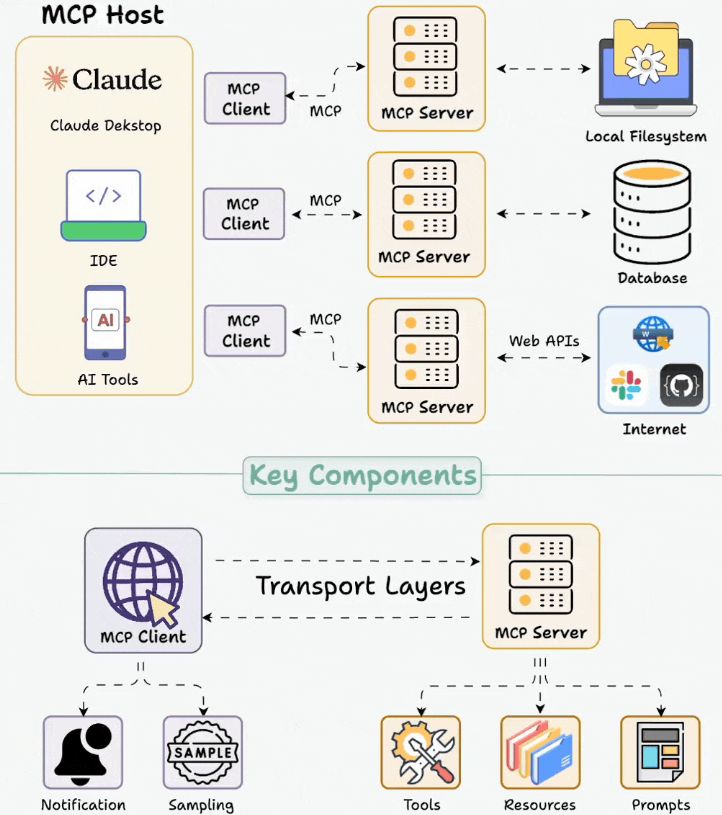
MCP architecture begins with clear boundaries between the model, client, server, and external systems.
What the Top Results Reveal About CTA Strategy
The Snyk guide has an educational security goal. Its likely audience includes developers and security-minded engineering teams who need a visual explanation before evaluating protection tools. The natural offer is a security platform, product documentation, or a related assessment. Its CTA works best when it follows a risk explanation rather than interrupting the opening definition.
The WorkOS article is developer-focused. It explains how MCP servers work and helps technical readers understand implementation and how to build MCP servers effectively. Its conversion path is likely a developer sign-up, documentation visit, or “start building” action. This is a warm B2B audience: readers have a technical problem and may be comparing ways to add identity, access, or application infrastructure.
The Zuplo article combines education with API infrastructure positioning. Its readers may want to build, publish, protect, or manage an mcp server. A documentation link, product trial, or implementation action is a natural next step. The offer is strongest when it appears beside practical API and deployment guidance.
Snyk pattern
Security education leads toward a security product or assessment. The tone is concerned but useful.
- Audience: B2B developers and security teams
- Stage: cold to warm research
- Action: explore security controls
WorkOS pattern
Protocol education leads toward implementation resources and developer onboarding.
- Audience: application and platform developers
- Stage: warm technical research
- Action: start building or register
Zuplo pattern
API education leads toward gateway, documentation, or managed infrastructure actions.
- Audience: API and platform teams
- Stage: cold to warm evaluation
- Action: test, deploy, or request help
Across these pages, the common CTA is not a direct purchase demand. It is a next technical step. That approach fits a complex protocol query and should guide this article’s conversion design.
What Is MCP Server Architecture?
MCP, or Model Context Protocol, is a protocol for connecting an AI host application to external capabilities. It provides the foundation developers need to build MCP servers that expose controlled tools, resources, and prompts. The host contains or manages an MCP client, which communicates with an MCP server to securely connect AI models with external systems.
The model does not normally connect to a database or SaaS API by itself. Instead, the application uses the client and server boundary. This separation creates a place for authentication, validation, policy checks, logging, and response filtering. The architecture defines how developers build MCP servers where clients, servers, tools, and models communicate with each other.
The main architecture components
- Model: Interprets context and proposes a tool call or response.
- Host: Runs the user-facing application and coordinates model interactions.
- MCP client: Maintains communication with one or more servers.
- MCP server: Publishes capabilities and executes approved logic.
- Tools: Actions that can read, write, search, calculate, or call an API.
- Resources: Context sources such as files, records, documents, or database views.
- Prompts: Reusable prompt templates or guided interaction patterns.
- Transport: The communication layer, such as stdio or HTTP.
- External systems: Databases, APIs, queues, files, and business services.
Keep the client, server, policy, and external-system boundaries explicit in design documents.
Why the boundary matters
The server should not become a hidden tunnel into every internal system. Each capability needs a defined purpose, input schema, permission rule, and output limit. This is one of the central MCP implementation best practices.
How Requests and Context Move Through the System
A typical request begins when a user asks the model to find information or perform an action. The host supplies model context and may include available capability descriptions from the client. The model proposes a tool call. The client checks whether the requested capability exists and sends a structured request to the server.
The server authenticates the connection, validates the message, checks authorization, and runs application logic. It may query a database or call another API. The result returns through the server and client to the host. The model then uses that result as context for its next response.
- The user submits a question or task to the host application.
- The model receives relevant context and available capabilities.
- The mcp client sends a structured request to the selected server.
- The server checks identity, permissions, schemas, limits, and policy.
- The server calls a database, API, file store, or internal service.
- The result is filtered, logged, and returned to the client.
- The host gives the model the approved result as new model context.
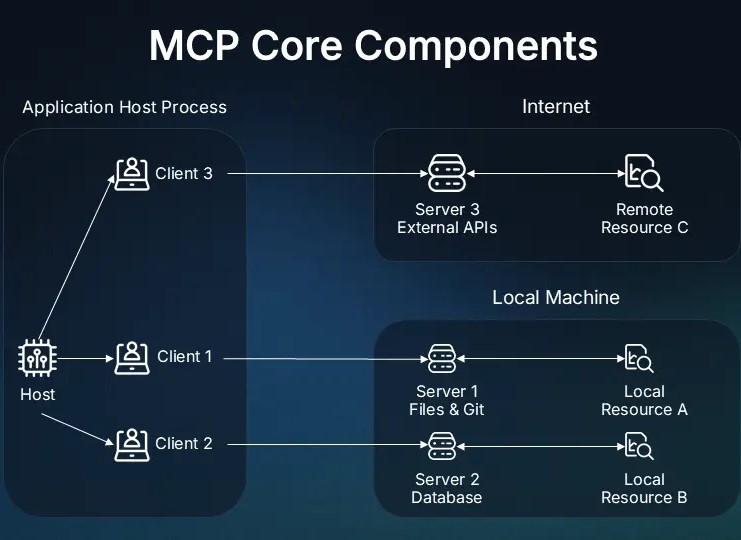
Document both the forward request path and the controls applied to the returning result.
Capabilities and discovery
Capability discovery lets a client understand what a server supports. The description must remain precise. A tool name should not imply more authority than the implementation grants. Descriptions should state limits, side effects, required fields, and failure behavior.
Transport choices
Stdio is common for local processes. HTTP is useful for remote servers, service routing, and centralized operations. Server-sent events may support streaming patterns where the client needs incremental results. Transport does not replace authentication or authorization. It only carries communication.
Turn the request path into a reviewable design
Use a one-page architecture checklist to map every model request, policy decision, tool call, and external data response.
Review the MCP specification
Local, Remote, and Hybrid MCP Servers
Deployment changes the trust boundary, latency profile, and operating model. Local servers run near the host application. Remote servers run as network services. Hybrid designs combine local access with centrally managed services.
| Model | Best use | Strength | Main concern |
| Local | Desktop workflows and private files | Low latency and simple setup | Local secrets and weak central oversight |
| Remote | Shared enterprise capabilities | Central policy, scaling, and monitoring | Network exposure and identity complexity |
| Hybrid | Sensitive local context plus shared services | Flexible data placement | More complex trust boundaries |
Local architecture
A local mcp server may use stdio and run as a child process. It can access approved files or developer tools without exposing an HTTP endpoint. This reduces network risk and often improves response time.
Local does not mean safe by default. A malicious configuration, unsafe dependency, or shared workstation can expose credentials. Use narrow file paths, process isolation, signed packages, and clear user confirmation for write actions.
Remote architecture
A remote server is better when many applications need the same capability. It can run in containers behind an API gateway or service mesh. Central logging, version control, health checks, and policy enforcement become easier.
The trade-off is operational complexity. Remote mcp servers need identity verification, TLS, network controls, rate limits, and high-availability planning. Private networking is preferred for sensitive enterprise systems.
Hybrid architecture
Hybrid designs keep user-specific or sensitive context local while routing shared capabilities to remote servers. For example, a local client may read an approved document set while a remote server performs a controlled business lookup.
Define which side owns each policy. Ambiguous responsibility can create gaps where local permissions and remote permissions disagree.
Choose the deployment model from data sensitivity and operational needs, not convenience alone.
Authentication, Authorization, and Permission Boundaries
Authentication answers who is connecting. Authorization answers what that identity may do. A secure design treats both questions as mandatory for remote mcp servers and important for local processes.
Identity verification
Use strong service identity for server-to-server communication. Depending on the environment, that may include short-lived tokens, mutual TLS, workload identity, or an approved identity provider. Do not place long-lived secrets in prompt text, tool arguments, source code, or client configuration files.
Least privilege and roles
Give each client, user, and service account only the capabilities it needs. Role-based access control can group permissions by job function. Permission boundaries should also limit resource scope, tenant scope, operation type, and time period.
- Separate read-only tools from write tools.
- Use different service accounts for development, testing, and production.
- Require stronger approval for deletion, payment, account changes, and bulk export.
- Expire credentials and rotate them through a managed secret store.
- Record the identity, purpose, tool, arguments, result, and policy decision.
Identity should travel with the request so every tool action can be evaluated and audited.
Token handling
Tokens should have narrow audiences and short lifetimes. The server should validate issuer, audience, expiry, scope, and tenant claims. Avoid forwarding a user token to systems that do not need it. Use token exchange or a scoped service identity when a downstream system requires different credentials.
Check your permission model
Request a practical review of identities, roles, service accounts, secret handling, and high-impact tool approvals.
Request an architecture review
Data Access Control and Tenant Isolation
Data access must be enforced below the model layer. A prompt can ask for a customer record, but the server must decide whether the identity and tenant may receive it. Never treat a model instruction as proof of permission.
Resource-level control
Assign permissions to resources, not only to tools. A “search records” tool may be safe for one tenant and unsafe for another. Apply filters at the database or service boundary. Do not fetch a broad result set and rely on the model to hide restricted rows.
Read and write separation
Read tools should not silently perform updates. Write tools should use separate handlers, schemas, audit events, and approval rules. For high-impact actions, show the intended operation and require explicit confirmation before execution.
Strong data controls
- Tenant identifiers come from verified identity claims.
- Queries enforce scope at the source.
- Sensitive fields are masked or omitted.
- Exports have volume and time limits.
Weak data controls
- Tenant IDs are accepted from user text.
- Broad database access sits behind one tool.
- Models receive raw secrets or private fields.
- Indirect tool calls bypass the first permission check.
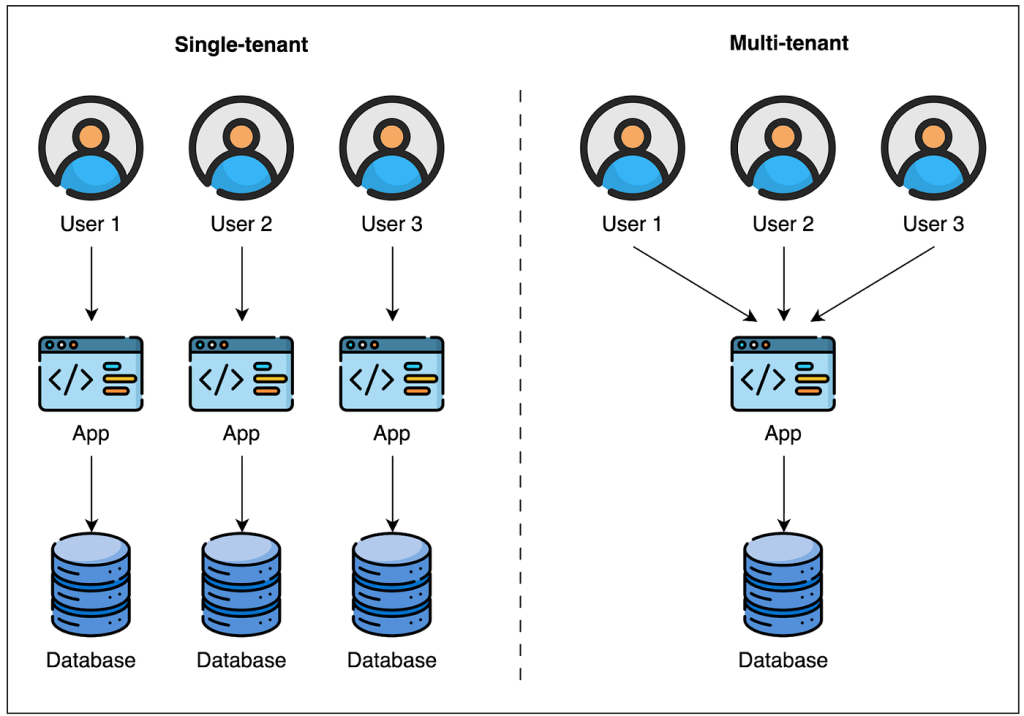
Tenant isolation should be enforced by trusted system data and database policy, not by model context alone.
Data minimization and auditability
Return only the fields needed for the task. Limit result counts, redact secrets, and avoid sending full documents when a short excerpt is enough. Audit the decision as well as the result. A useful record explains why access was allowed, not only what data was returned.
How to Expose Tools Securely
Tools are the action surface of an mcp server. Each one should be treated like a public API endpoint, even when it is available only to an internal client.
Validate every input
Use strict schemas for types, ranges, lengths, formats, and allowed values. Reject unknown fields when practical. Normalize paths, URLs, identifiers, and encodings before policy checks. Validation should run on the server, not only in the client.
Control output and side effects
Filter output fields and cap response size. Do not return stack traces, credentials, internal network details, or raw database errors. Mark tools with side effects clearly. A read tool and a delete tool should not share one vague name or handler.
- Use allowlists for commands, domains, file paths, and operations.
- Apply rate limits by identity, tenant, tool, and cost.
- Sandbox code that processes untrusted files or content.
- Require confirmation for irreversible or expensive actions.
- Use idempotency keys for actions that may be retried.
- Log policy failures without exposing secret values.
Prompt injection and tool abuse
External content may contain instructions aimed at the model. Treat retrieved text as data, not authority. Keep system policy outside untrusted context, label sources, and require the server to enforce permissions independently. A model may be tricked into requesting a tool, but it must not be able to grant itself access.
Design tools as small, testable capabilities with clear authority and predictable failure states.
Important security boundary
Prompt instructions can guide behavior, but they are not an authorization system. Policy code and trusted identity data must decide access.
Enterprise MCP Deployment Patterns
An enterprise MCP framework should standardize how servers are registered, secured, observed, deployed, and retired. It should not force every team into one identical implementation.
Centralized gateway
A gateway can provide authentication, routing, rate limits, policy checks, and consistent logs. It is useful when many clients call many servers. Avoid turning it into one oversized business-logic service. Keep domain logic in focused servers.
Per-team or per-application servers
Teams can own servers aligned with their data and services. This improves accountability and release speed. Governance still needs shared rules for schemas, identity, logging, testing, and incident response.
Service mesh and private networking
A service mesh can provide workload identity, encryption, traffic policy, and telemetry. Private network paths reduce exposure to the public internet. Network controls are helpful, but they do not replace application authorization.
High availability and operations
Run remote servers in containers when that matches the organization’s platform model. Add health checks, readiness checks, autoscaling limits, and graceful timeouts. Keep deployments repeatable through infrastructure as code and signed artifacts.
Observe
Track latency, errors, request volume, tool usage, policy denials, and unusual access patterns.
- Structured logs
- Traces and correlation IDs
- Security alerts
Govern
Maintain an inventory of servers, owners, tools, data classes, permissions, and lifecycle status.
- Review schedules
- Approval records
- Version policies
Maintain
Test changes, rotate secrets, patch dependencies, and retire unused capabilities.
- Release controls
- Rollback plans
- Dependency scanning
Standardize the platform controls while allowing teams to own focused domain capabilities.
Common MCP Architecture Mistakes
The most serious failures usually come from unclear authority. A tool may appear small while its underlying credential can reach an entire business system.
- One shared credential for every client
- Broad tools with hidden side effects
- Tenant scope taken from prompt text
- Direct exposure of internal systems
- Raw errors and unrestricted results
- Short-lived, scoped identities
- Separate read and write capabilities
- Tenant scope from verified claims
- Policy gateway and private service paths
- Filtered output and safe error handling
Do not treat local and remote systems as identical
Local servers have process, package, and workstation risks. Remote servers have network, identity, scaling, and multi-tenant risks. The controls overlap, but the threat models are different.
Do not overtrust capability descriptions
A description helps the model choose a tool. It does not constrain the implementation. Enforce every rule in code and test it with malformed input, unexpected identity claims, replay attempts, and prompt injection content.
Do not skip lifecycle management
Unused servers and tools expand the attack surface. Assign an owner, record dependencies, review permissions, and remove capabilities that no longer have a business purpose.
Use architecture reviews to find excessive authority before a server reaches production.
Reference Architecture and Implementation Checklist
A secure reference design starts with the host and mcp client, then places identity and policy controls around each remote server. Local servers should remain narrowly scoped. External systems should be reached through approved adapters, not unrestricted network access.
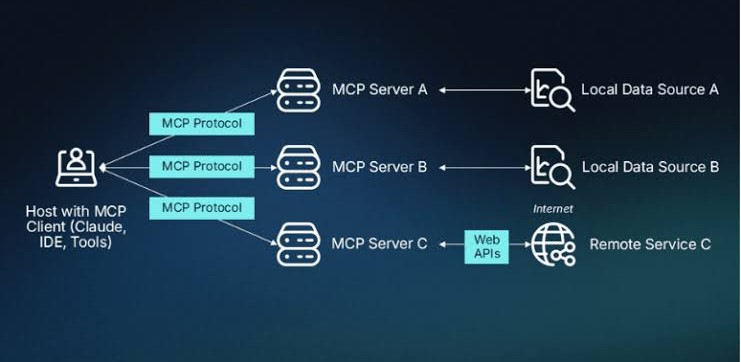
Reference flow: identity, client, policy, server, tool, external system, filtered result, and audit event.
Production readiness checklist
- Every server has an owner, purpose, version, and data classification.
- Every tool has a strict schema, side-effect label, permission rule, and output limit.
- Every remote connection uses authenticated and encrypted communication.
- Every identity has narrow scope, rotation, expiry, and revocation procedures.
- Every tenant query is enforced at the service or database boundary.
- Every high-impact action has confirmation, approval, or compensating control.
- Every request has correlation data for audit and incident investigation.
- Every deployment has health checks, rollback steps, and dependency monitoring.
- Every prompt injection test confirms that untrusted content cannot grant access.
- Every unused server, tool, credential, and route is removed.
Practical decision guide
Choose local deployment when the data is personal or device-bound and central management is not required. Choose remote deployment when shared access, governance, and scale matter. Choose hybrid deployment when sensitive context must stay close to the user while common services remain centrally managed.
In all three cases, keep policy enforcement close to the action. The model can propose. The client can coordinate. The server must validate and authorize.
Request a secure architecture review
Share your deployment model and the controls you need to validate. Keep the form focused on implementation goals rather than sensitive credentials.NameWork emailArchitecture goals
Do not include passwords, tokens, private keys, or customer records.Request the review
Build with a clear security boundary
Use the checklist to compare local, remote, and hybrid options, then validate identity, data access, tool safety, and operations before launch.
Start your architecture review
A strong MCP server architecture is not defined by one transport or deployment pattern. It is defined by clear authority, narrow capabilities, controlled data, observable behavior, and a lifecycle that keeps risk in check.